



- Description
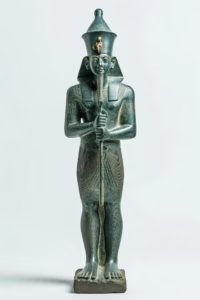
Osiris, Isis & Horus (Hephaestion of Thebes, 400 CE)
The Egyptian Gods of the Heavens, Underworld, Prosperity & Resurrection
Moon in Pisces, Venus in Taurus & Jupiter in Cancer
"Osiris in Taurus, Pisces and Aquarius."
- Hephaestion of Thebes, 415 AD, Egypt

"The power of the earth, both the celestial and terrestrial earth, they called Isis, because of the equality, which is the source of justice: but they call the moon the celestial earth, and the vegetative earth, on which we live, they call the terrestrial."
"Demeter has the same meaning among the Greeks as Isis among the Egyptians: and, again, Kore and Dionysus among the Greeks the same as Isis and Osiris among the Egyptians. Isis is that which nourishes and raises up the fruits of the earth; and Osiris among the Egyptians is that which supplies the fructifying power, which they propitiate with lamentations as it disappears into the earth in the sowing, and as it is consumed by us for food."
"Osiris is also taken for the river-power of the Nile: when, however, they signify the terrestrial earth, Osiris is taken as the fructifying power; but when the celestial, Osiris is the Nile, which they suppose to come down from heaven: this also they bewail, in order to propitiate the power when failing and becoming exhausted. And the Isis who, in the legends, is wedded to Osiris is the land of Egypt, and therefore she is made equal to him, and conceives, and produces the fruits; and on this account Osiris has been described by tradition as the husband of Isis, and her brother, and her son."
Source
Hephaestion of Thebes was a Hellenized Egyptian astrologer who lived in Roman Egypt during the fall of the Western Roman Empire. Around 400-415 AD, the same time that Emperor Theodosius issued his decree ordering the destruction of all pagan temples and making their practices a capital crime in Rome’s provinces, Hephaestion wrote his three volumes on astrology. In the third volume “On Inceptions” he provides instructions for crafting temple statue and sacred images of many ancient gods.
“In the temples one must enthrone the statues (agalmata), after they have been made in the fitting form, and of suitable material, as the wise Egyptians and the rest of the ancients have transmitted, when the Moon is filling and has appeared in her phase. The powers of such images, when they are completed in harmony with the heavens’ movement, are produced more ‘theōdéstera’ (more god-filled) and ensouled.
“And each of the sacred objects and statues is advantageous to fashion and enthrone while the Moon is in Jupiter’s trigon [triplicity] and while Jupiter is harmonious with her. That is, in the same trigon, and likewise when the Sun has been configured in the same way, and Saturn likewise happens to be in his own trigon.
“And for the rest of the stars [planets] one must in the same way prepare both the sacred objects and the statues. It is auspicious, whenever they themselves are in their exaltations and domiciles, to fashion them, if no malefic stars [planets] opposes.”
(Hephaestion of Thebes Book III 7.13-18)
Hephaestion of Thebes requires a considerable number of factors to be present for the ensoulment of a sacred image. The triplicity rulers according to Dorotheus are considered, as well as the luminary of sect (Sun in day and Moon at night) having a harmonious configuration. The three triplicity rulers signify the beginning, middle and end.
He adds that they should be crafted when the exaltation or domicile ruler is present in the god’s sign, which is standard for a planetary election. The significators must not make hard aspects with the malefics, Saturn and Mars, and be made with suitable material.
Hephaestion’s work pairs well with the writings of Julianus of Laodecia. Around 480 CE, Julianus wrote a short treatise on the use of astrological elections or inceptions, meaning “beginnings” or the moment in which a temple statue is ensouled. He was a pagan philosopher and member of the New Academy and likely studied there while Proclus was head of the school. His treatise was written during the reign of Justinian, who effectively outlawed the New Academy in the Eastern Roman Empire and caused many philosophers to flee to Persian territories. This is believed to have been the cause of the Academy founded in Harran, which later provided much of the material that became the Ghayat al Hakim or Picatrix.
From a historical standpoint, these two texts are significant because they both predate Catholicism as the state religion of Rome. Hephaestion lived in Egypt when it was a province of the Western Roman Empire and Julianus in Athens, part of the Eastern Roman empire.
Like many works of Hellenistic astrology, these are short compared to medieval sources. The recommended astrological considerations are numerous and stringent, and place a notable emphasis on doryphory, also called attendants or spear-bearers as well as the sect (day or night). Nocturnal charts are used for chthonic (underworld) gods and diurnal for the celestial. Both recommend that the Moon in night charts and Sun in day charts aspect at least one planet for support.
“Sweats (life) will be [produced] if the gods are chthonic, with Selene, Aphrodite, and Zeus testifying (bearing witness) to one another, and let Kronos also testify to them in harmony….with male gods….the same rule applies to all.”
Julianus recommends that the Moon, Venus and/or Jupiter aspect each other and Saturn lend his support for nocturnal gods and goddesses of the underworld, and to apply this principle for the diurnal gods. The Moon aspecting both benefics ensures that the most benevolent astral influences are imprinted into the image, and Saturn will not hinder it. These astrological configurations complement those of Hephaestion. When paired with the more thorough details found in Picatrix, they are a fascinating look at one of the most heavily suppressed branches of knowledge from the ancient world.
Election
"Osiris in Taurus, Pisces and Aquarius." - Hephaestion of Thebes
“And each of the sacred objects and statues is advantageous to fashion and enthrone while the Moon is in Jupiter’s trigon [triplicity] and while Jupiter is harmonious with her. That is, in the same trigon, and likewise when the Sun has been configured in the same way, and Saturn likewise happens to be in his own trigon.
Hephaestion places considerable emphasis on the triplicity rulers much like Dorotheus of Sidon five centuries before him. During his life, three triplicity rulers were considered. Two rulers and a participating ruler came into use in the medieval period. He describes the most optimal astrological conditions to use, simple and straightforward, and the reader must find a time that matches it closely enough. This is how Julianus wrote his text on ensouling temple statues with astrological timing. The Moon and significator must not apply to a square or opposition with a malefic. The Luminary of Sect should ideally make applying aspects to benefics and/or their triplicity rulers whenever possible. At a minimum, the triplicity rulers of the significator’s sign should not be severely afflicted. He concludes that all remaining sacred images should be "completed and renewed when the Moon is in the aforesaid signs" (III.7.17–18).
Election Chart
14 April, 2026 04:40 AM
